
An identity crisis masked by success is defined as the persistent internal conflict that emerges when external achievement outpaces internal self-definition. High achievers experience this more often than conventional wisdom admits. Only 35% of people reach full self-authorship, the developmental milestone where identity is self-defined rather than externally validated. That gap explains why so many accomplished executives and leaders feel hollow despite every marker of success pointing the right direction. The clinical term for this experience is an identity crisis, and learning to recognize when success masks identity crisis is the first step toward genuine resolution.
How can you recognize the signs that success is masking an identity crisis?
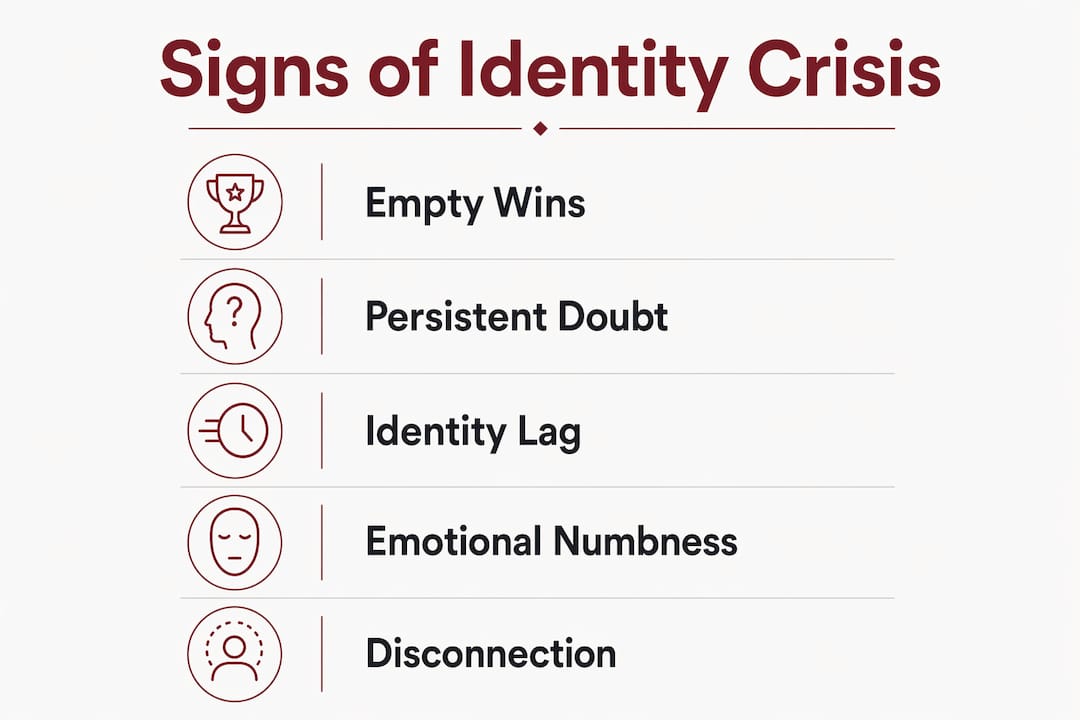
The clearest signal is a persistent sense of emptiness after a win. You close the deal, earn the promotion, or hit the revenue target, and instead of satisfaction, you feel nothing. High achievers risk "identity erosion" when achievement becomes the primary nervous system regulator, meaning the brain has learned to calm itself through accomplishment rather than through a stable sense of self. When the accomplishment arrives, the regulator fires and then goes quiet, leaving a vacuum.

Psychologists describe a related pattern called "Identity Lag." Identity Lag occurs when external achievements outpace internal self-concept, creating a misalignment between who you have become on paper and who you still believe yourself to be inside. It shows up as performance that feels mechanical, decisions that feel borrowed from an older version of yourself, and a creeping sense that the role fits poorly even though everyone else thinks it fits perfectly.
Specific symptoms to watch for include:
- Chronic fatigue that rest does not fix. Sleep and vacations provide no real recovery because the exhaustion is existential, not physical.
- Irritability without a clear cause. Small frustrations trigger disproportionate reactions because the underlying tension has nowhere else to go.
- Social withdrawal. Identity crisis symptoms include decreased motivation and social withdrawal that interfere with daily functioning, not just occasional introversion.
- Disconnection from your own opinions. You struggle to answer "What do I actually want?" without referencing your role or your résumé.
- Compulsive busyness. Staying relentlessly occupied prevents the quiet moments where the dissonance becomes audible.
Burnout and an identity crisis overlap but are not the same condition. Burnout resolves with rest and reduced load. An identity crisis does not. If two weeks off leaves you feeling more anxious rather than restored, the problem is not workload.
Pro Tip: Set a five-minute timer each morning and write one sentence answering "Who am I when no one is watching?" If the answer changes dramatically from day to day, or if you cannot answer at all, that instability signals identity work, not performance work.
What mindset shifts prepare you to address identity struggles in success?
The foundational concept here comes from developmental psychology. Robert Kegan's framework distinguishes between the "socialized mind," which defines identity through external roles and approval, and the "self-authoring mind," which builds identity from internal values. Most high achievers built their careers operating from the socialized mind. It worked. The problem is that continued success eventually demands the shift to self-authorship, and that shift feels like losing ground even when it represents growth.
Three mindset shifts make the transition possible:
- Replace urgency with curiosity. Clinical experts recommend curiosity over urgency when responding to identity dissonance. Asking "Whose life am I building?" opens inquiry. Demanding an immediate answer closes it.
- Accept that success accelerates the crisis. Success validates the old identity narrative, which makes it harder to recognize when that narrative has been outgrown. Seeing success as an accelerant rather than a contradiction removes the shame from the experience.
- Practice self-compassion as a discipline. Identity work surfaces grief. You are releasing a version of yourself that worked hard and earned real results. Treating that release as failure stalls the process. Treating it as maturation keeps it moving.
Setting honest boundaries around your time also matters here. Identity inquiry requires unstructured space. Calendars packed from 6 AM to 10 PM leave no room for the kind of reflection that produces genuine self-knowledge. Protecting even 20 minutes of daily unscheduled time is a structural act of self-authorship.
What practical strategies help you navigate and integrate identity shifts?
The process of resolving the tension between success and identity follows a recognizable sequence. Working through it deliberately produces lasting results. Skipping steps produces temporary relief followed by the same dissonance in a new context.
- Audit your current identity narrative. Write down the five words you use most often to describe yourself in professional settings. Then ask whether those words describe who you are or what you do. The gap between those two answers is the starting point.
- Question the origin of each identity element. For each word or role you identified, ask: Did I choose this, or did I inherit it from family expectations, industry culture, or early career necessity?
- Release outdated identity assumptions. High achievers who try to fix identity misalignment with more effort consistently fail to resolve it. True progress requires releasing old constructs, not adding new skills on top of them.
- Build a new self-narrative. Write a one-paragraph description of yourself that contains no job titles, revenue figures, or credentials. This exercise is harder than it sounds and more revealing than most assessments.
- Test the emerging identity in low-stakes settings. Volunteer for a project outside your expertise. Have a conversation where you admit uncertainty. Notice how it feels to be a beginner again.
| Strategy | What it addresses |
|---|---|
| Identity narrative audit | Surfaces the gap between role and self |
| Origin questioning | Identifies inherited versus chosen values |
| Releasing old constructs | Breaks the achievement-as-identity loop |
| New self-narrative writing | Builds identity independent of credentials |
| Low-stakes identity testing | Affirms the emerging authentic self |
Somatic awareness accelerates this work. Somatic regulation anchored in identity rather than achievement eases transitions and reduces the feelings of emptiness that accompany major life chapter changes. Paying attention to how your body responds during different activities, expanded chest and easy breathing versus tight shoulders and shallow breath, gives you data your mind often overrides.
Pro Tip: Use journaling prompts that bypass the achiever brain. Try: "If my career disappeared tomorrow, what would I still care about?" Write for ten minutes without editing. The unguarded answers carry more identity information than any structured assessment.
What obstacles block you from resolving a success-masked identity crisis?
The most common mistake is misreading the crisis as a performance problem. When internal dissonance surfaces, the trained high-achiever response is to work harder, learn a new skill, or hire a better team. Pushing harder into achievement functions as an avoidance strategy that temporarily suppresses the discomfort without addressing its source. The result is a cycle of escalating effort and diminishing internal return.
Other common obstacles include:
- Isolation. Identity work feels private and exposing. High achievers often avoid sharing the experience, which removes the external feedback that helps calibrate self-perception.
- Misdiagnosis. Professional coaching and therapy prevent misdiagnosis of identity crisis as burnout or a performance issue. Without professional support, the wrong intervention gets applied to the right problem.
- Impatience with the process. Identity reconstruction does not follow a quarterly timeline. Expecting resolution in weeks produces frustration that masquerades as evidence the work is not working.
- Absence of a supportive environment. Social support and professional help are crucial for validation and managing distress during identity transitions. Attempting this work entirely alone significantly reduces the odds of success.
"Success validates the old identity narrative, making it harder to recognize when it's outgrown. Releasing that identity is an act of courage, not failure. The executives who move through this transition most effectively are not the ones who push hardest. They are the ones who pause longest."
The leaders who emerge from this process show a recognizable shift. Mature leadership after an identity crisis becomes quieter and more internally aligned, with less attachment to proving and external validation. That shift is not a loss of ambition. It is ambition directed by a self that actually exists.
Key Takeaways
Success masking an identity crisis is a developmental challenge, not a personal failure, and resolving it requires releasing outdated identity constructs rather than adding more achievement on top of them.
| Point | Details |
|---|---|
| Identity crisis is distinct from burnout | Rest resolves burnout; identity work resolves the deeper dissonance that rest cannot touch. |
| Identity Lag is the core mechanism | External achievements outpacing internal self-concept creates the misalignment high achievers feel. |
| Curiosity accelerates resolution | Asking "Whose life am I building?" opens the inquiry that urgency and harder effort close. |
| Release outpaces skill-building | Adding credentials or effort to an outdated identity narrative deepens the crisis rather than resolving it. |
| Professional support changes outcomes | Coaching and therapy prevent misdiagnosis and provide the feedback loop identity work requires. |
What I have learned from sitting with this work
The executives I work with most often arrive convinced they have a strategy problem or a relationship problem. They are rarely wrong about the symptoms. They are almost always wrong about the cause. The real issue sits underneath the presenting complaint, in the gap between the identity that earned the success and the person who now has to live with it.
What strikes me consistently is how much courage this work actually requires. Letting go of the "achiever" identity feels like professional suicide to someone who built everything on it. The case studies I have seen confirm the opposite. The leaders who do this work do not become less effective. They become effective in ways that actually sustain them.
The conventional wisdom says that success and a strong sense of self reinforce each other. My experience says they often do not, at least not automatically. Success can calcify an identity that was always provisional. The work is not about dismantling what you built. It is about deciding who is going to live in it going forward.
— Rock
Rock DuBois can help you rebuild from the inside out
The internal conflict between achievement and authentic identity does not resolve on its own. It deepens until something forces the reckoning.
Rock DuBois works specifically with high-achieving executives and leaders who have reached the point where external success no longer explains the internal experience. The RECONSTRUCTION METHOD is built for exactly this transition. It moves past surface-level performance coaching to excavate the identity misalignments that produce chronic stress, relationship breakdown, and the quiet sense that something important is missing. Clients report a 90+% reduction in anxiety following a session. If you recognize the patterns described here, the next step is a direct conversation about what the work actually looks like for your situation.
FAQ
What is an identity crisis in the context of success?
An identity crisis in the context of success occurs when external achievement outpaces internal self-definition, leaving high achievers feeling empty or disconnected despite visible accomplishment. Clinically, it involves confusion about values, roles, and personal meaning that persists regardless of performance outcomes.
How is Identity Lag different from burnout?
Identity Lag is the misalignment between who you have become externally and who you still believe yourself to be internally. Burnout resolves with rest and reduced workload; Identity Lag requires releasing outdated identity constructs and building a new self-narrative.
At what age does success most often trigger an identity crisis?
Identity crises linked to success most commonly surface between ages 35 and 45, which aligns with the developmental window when the shift from a socialized mind to a self-authoring mind typically occurs.
Can you resolve a success-masked identity crisis without professional help?
Self-directed tools like journaling and somatic awareness support the process, but professional coaching or therapy significantly improves outcomes by preventing misdiagnosis and providing the external feedback that identity work requires.
What does healthy identity look like after resolving this crisis?
Post-crisis identity tends to be quieter and more internally directed, with less reliance on external validation. Leaders who complete this work report clearer values, stronger relationships, and ambition that feels chosen rather than compelled.