
Founder identity is defined as the psychological self-concept a person builds around their role as an entrepreneur, and it is the single most powerful force shaping how they lead, decide, and recover from failure. The role of identity in founder psychology reaches far beyond motivation. It determines risk tolerance, colors every leadership decision, and either protects or destroys psychological health when the business hits turbulence. Research confirms that founders who maintain identities independent of their company sustain healthier psychological states and avoid burnout. Rock DuBois works with high-performing founders on exactly this issue, because the gap between outward success and inner alignment is where the real damage happens.
How does founder identity shape entrepreneurial behavior?
Founder identity acts as a behavioral compass. Every decision a founder makes, from which markets to enter to how they respond to a bad quarter, runs through the filter of who they believe they are. A founder who sees herself as a “builder” will push through product pivots with energy. A founder who defines himself purely as a “winner” will struggle to process a failed launch without a personal crisis.
The psychological concept of identity salience explains this pattern. When the founder role sits at the top of a person’s identity hierarchy, it crowds out every other self-concept. That concentration creates both extraordinary drive and extraordinary fragility. The Founder Authority Effect shows the upside: authentic founder stories build brand trust that competitors cannot replicate, because personal credibility transfers directly to company credibility.
Identity also shapes leadership style in ways founders rarely notice. A founder who grew up in scarcity leads with urgency and frugality. A founder whose origin story centers on being underestimated leads with a chip on her shoulder that can either fuel performance or poison team culture. The role of origin story in founder identity is not just a branding exercise. It is a map of the unconscious rules that govern every leadership choice.
Pro Tip: Write your origin story in 200 words and then list the three rules it implies. Those rules are running your company whether you know it or not.
- Identity salience determines which decisions feel obvious and which feel paralyzing.
- Authentic founder narratives pre-establish trust before a sales conversation begins.
- Origin stories reveal unconscious leadership rules that shape team culture.
- Risk tolerance is not a fixed trait. It shifts based on how central the founder role is to self-worth.
What psychological traits define founders, and what is the cost?
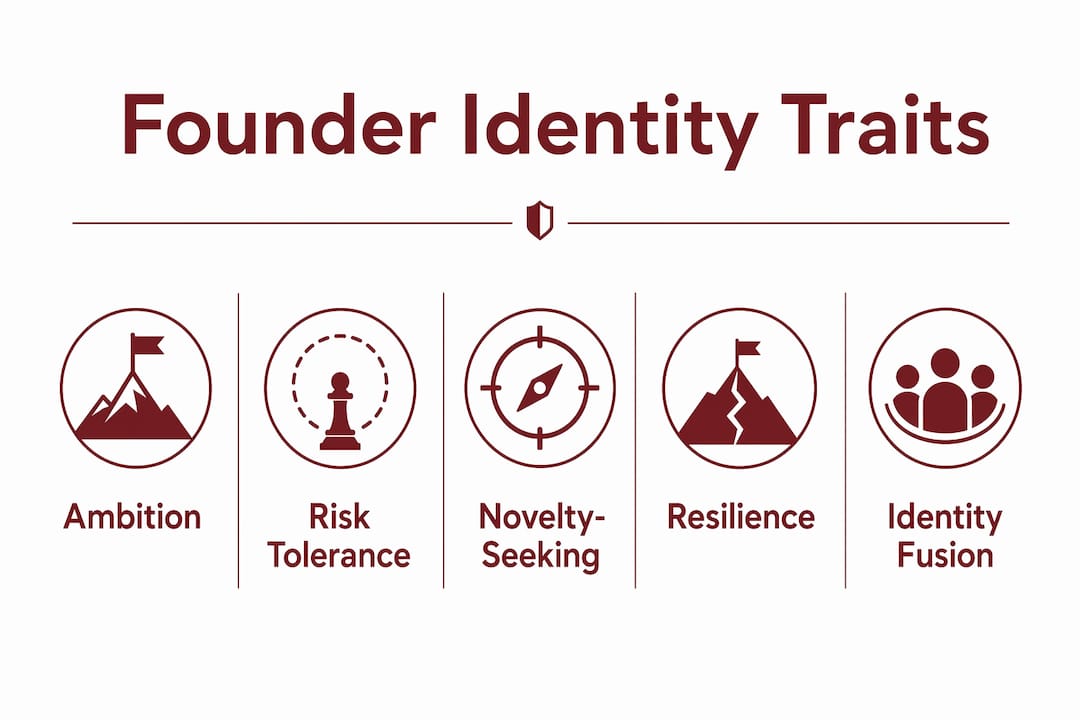
Novelty-seeking, high risk tolerance, and relentless ambition are the traits that most consistently appear in successful founders. These traits are not accidents. They are the engine that converts an idea into a company. The problem is that the same engine runs hot enough to burn the driver.
Research is direct on this point: novelty-seeking and ambition fuel startup success but require structural supports to prevent burnout. Without those supports, the urge for rapid learning and constant possibility tips into overextension and emotional exhaustion. The trait that got you to Series A is the same trait that keeps you awake at 3 AM convinced the whole thing is about to collapse.
The biggest misconception founders carry is that ambition must equal full identity fusion with the company. Ambition can be honored without total identity entanglement. The distinction matters because identity fusion is what turns a bad quarter into an existential crisis.
Pro Tip: Track how many of your weekly activities exist outside business metrics. If the number is zero, your identity has fused with your company. That is a risk factor, not a badge of honor.
Here is a practical framework for recognizing dual-effect traits:
- Novelty-seeking. Drives product innovation and market sensing. Unchecked, it produces constant pivoting and team instability.
- Risk tolerance. Enables bold bets and capital raises. Without reflection, it becomes recklessness that burns investor trust.
- Ambition. Sustains long-term vision. Fused with identity, it makes every setback feel like personal annihilation.
- Resilience. Keeps founders moving through failure. Misapplied, it becomes a reason to ignore legitimate warning signs.
- Autonomy drive. Produces decisive leadership. Overextended, it creates founders who cannot delegate and teams that cannot grow.
How does founder identity evolve through venture stages?
Founder identity is not fixed. It constantly shifts as founders renegotiate and reconstruct their self-concept in response to social feedback and venture transitions. Early-stage founders often carry a scrappy, “prove it” identity. Scaling-stage founders face pressure to become managers, executives, and public figures, roles that can feel foreign and threatening to the original self-concept.

The most dangerous phase for identity loss is scaling or acute market pressure. Veteran founders identify this clearly: separating professional identity from company outcomes is a survival strategy, not a sign of reduced commitment. The founder who confuses detachment with disloyalty will fuse self-worth with stock price and become incapable of clear-headed crisis leadership.
The stakes are not abstract. Strong identity fusion with company outcomes has been linked to extreme burnout and, in documented cases, suicide during economic downturns. Chip Conley’s account of losing entrepreneur friends during downturns is a direct illustration of what happens when a person’s entire sense of worth collapses with a company’s valuation.
| Venture stage | Identity risk | Protective strategy |
|---|---|---|
| Ideation | Overconfidence in founder vision | Seek early external feedback |
| Early growth | Role confusion as team expands | Define identity beyond "founder" title |
| Scaling | Identity fusion with company metrics | Build competence in non-business domains |
| Crisis or pivot | Self-worth collapse tied to outcomes | Practice identity disidentification |
| Exit or transition | Loss of purpose post-company | Establish personal narrative independent of the venture |
Self-determination theory applied to founders shows that psychological health depends on three needs: autonomy, competence, and relatedness. When competence becomes entirely dependent on company success and relatedness shrinks to the founding team, the psychological foundation becomes dangerously narrow.
Practical strategies for building a resilient founder identity
Founder resilience comes from building a personal identity that survives business failures, not from tying self-worth solely to company outcomes. That is a structural change, not a mindset tweak. It requires deliberate practice and, often, outside support.
Identity work is a recognized coping mechanism that protects founders from burnout by reframing adversity and sustaining motivation under pressure. Redefining yourself as resilient, visionary, and flexible is not self-help language. It is a documented psychological strategy that changes how founders process setbacks and allocate energy.
Practical strategies that work:
- Diversify your identity sources. Pursue one domain, whether it is physical training, creative work, or community involvement, where your competence has nothing to do with your company’s performance.
- Use your origin story as a strategic asset. Successful founder narratives connect prospects with shared struggles and values. They shift sales conversations by pre-establishing trust before a pitch begins.
- Build a complementary team. Surround yourself with people whose strengths expose your blind spots. This reduces the pressure to be everything, which is a primary driver of identity overload.
- Separate achievement from worth. Read about why achievements alone fall short as a foundation for self-esteem. The founder who ties worth to outcomes will always need a bigger outcome.
- Schedule identity audits. Quarterly, ask yourself: who am I outside this company? If the answer is thin, treat it as a business risk, because it is one.
Healthy founders derive competence and purpose from multiple sources beyond business metrics. That multiplicity is not a distraction from the company. It is the psychological infrastructure that keeps the founder functional when the company hits its inevitable hard stretch.
Key Takeaways
Founder identity is the psychological core that determines how entrepreneurs lead, cope, and sustain performance across every stage of a venture.
| Point | Details |
|---|---|
| Identity shapes every decision | Founder self-concept filters risk tolerance, leadership style, and crisis response before logic enters. |
| Trait duality is real | Novelty-seeking and ambition drive success but require structural balance to prevent burnout. |
| Scaling is the danger zone | Identity fusion with company metrics peaks during growth phases and requires active separation. |
| Origin stories are strategic | Authentic founder narratives build brand trust that product features alone cannot create. |
| Resilience is structural | Psychological health depends on competence and purpose drawn from multiple life domains, not just the company. |
What I have learned working with founders on identity
The pattern I see most often is not ambition. It is invisibility. Founders come to me having built something genuinely impressive, and they cannot tell me who they are outside of it. The company became the answer to every identity question, and now the company is struggling, or they sold it, or they are simply exhausted, and there is nothing left underneath.
The conventional advice is to “find balance.” That advice is useless without a prior step: you have to know what you are balancing against. Most founders have not done that work. They have been too busy building to notice that they stopped being a person and became a function.
What I have found is that the founders who navigate hard transitions best are the ones who treated their identity as something worth tending, not just their company. They had relationships that had nothing to do with their cap table. They had skills that had nothing to do with their product. They had a story about themselves that did not begin and end with their startup.
The uncomfortable truth is that identity work is not a retreat from ambition. It is the foundation that makes sustained ambition possible. A founder with a thin identity is one bad quarter away from a breakdown. A founder with a rich, layered sense of self is someone who can lose a funding round on Monday and still lead clearly on Tuesday.
If you are reading this and recognizing yourself, that recognition is not a weakness. It is the first data point you need to do something about it.
— Rock
Working with Rock DuBois on founder identity
Rock DuBois works specifically with high-performing founders and executives who have built significant success but feel the growing gap between what they have achieved and who they actually are. This is not surface-level coaching. The work goes into the identity structures underneath the performance, the beliefs, the origin stories, and the fused self-concepts that are driving behavior in ways most founders never examine.
Clients who engage in identity reconstruction with Rock DuBois report a 90% reduction in anxiety following a session, not because the business problems disappear, but because the psychological weight of carrying a fused identity gets lifted. If your success feels hollow or your stress feels disproportionate to your circumstances, the issue is almost certainly identity, not strategy. The next step is a direct conversation about what is actually driving the gap.
FAQ
What is the role of identity in founder psychology?
Founder identity is the self-concept built around the entrepreneurial role, and it shapes every decision, risk assessment, and leadership behavior a founder exhibits. When this identity is healthy and multifaceted, it supports resilience. When it fuses entirely with company outcomes, it becomes a psychological liability.
How does a founder’s origin story affect their leadership?
A founder’s origin story encodes unconscious rules that govern leadership style, team culture, and brand positioning. Research on the Founder Authority Effect shows that authentic origin stories also build customer trust that product features alone cannot replicate.
What psychological traits are most common in founders?
Novelty-seeking, high risk tolerance, and ambition are the traits most consistently associated with successful founders. These same traits require structural support to prevent burnout and identity overextension.
When is founder identity most at risk?
Scaling and acute market pressure are the highest-risk phases for identity loss. Founders who confuse separating their identity from company outcomes with a lack of commitment are most vulnerable to burnout and crisis leadership failures.
How can founders build a more resilient identity?
Founders build resilience by diversifying their sources of competence and purpose beyond the company, using identity work to reframe adversity, and maintaining relationships and skills that exist entirely outside the business.