
Identity work is the deliberate process of examining and reshaping how you understand yourself, your role, and what you want your life to mean. For founders, this process is not optional. The gap between building a company and leading one is almost always an identity gap, not a skills gap. Founders who close that gap report clearer decisions, stronger teams, and far less of the chronic anxiety that quietly erodes both performance and fulfillment. Understanding how identity work transforms founder clarity is the first step toward closing it.
How identity work transforms founder clarity through key identity shifts
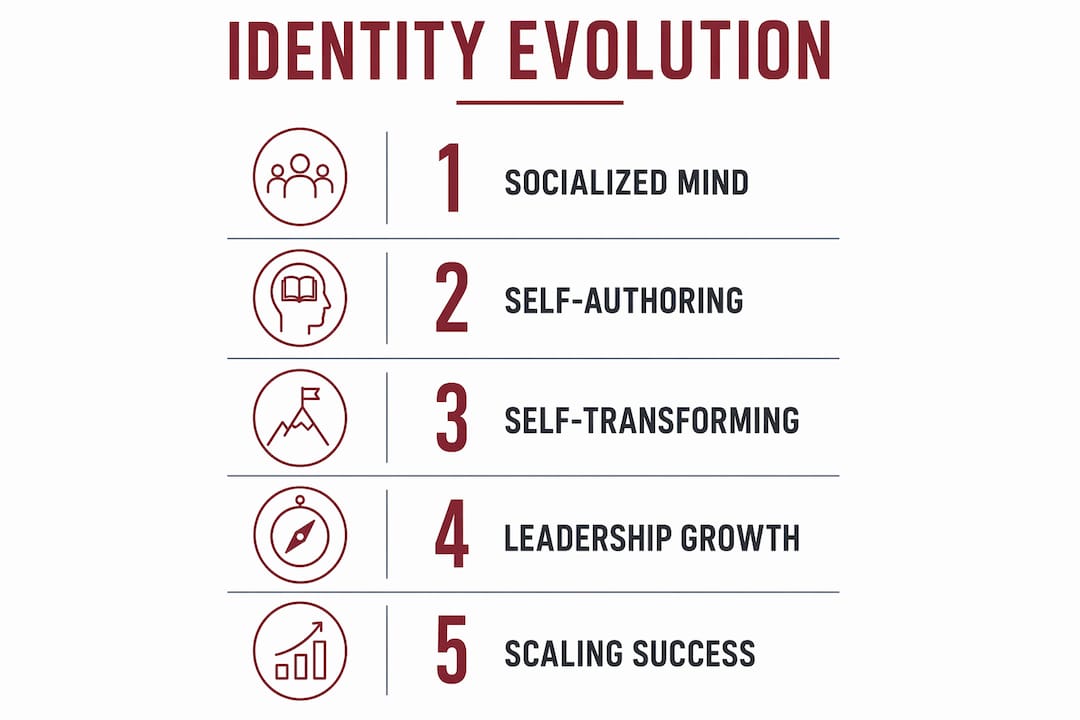
The most important shift a founder can make is not strategic. It is psychological. Robert Kegan’s framework of adult development describes three stages most relevant to founders: the socialized mind, the self-authoring mind, and the self-transforming mind. Each stage represents a fundamentally different way of processing reality and making decisions.
The socialized mind defines itself through external validation. Founders at this stage build companies to prove something to someone. The self-authoring mind generates its own values and direction. This is where most high-performing founders operate. The self-transforming mind goes further. It holds contradictory truths at once, questions its own frameworks, and leads from a place of genuine flexibility. Identity work shifts founders from socialized or self-authoring minds to self-transforming minds, enabling scaling beyond $10M. That shift is not a personality upgrade. It is a structural necessity.

The hardest part of this evolution is what practitioners call “ego death.” Scaling companies requires founders to evolve identity from scrappy starter to strategic CEO, involving cognitive dissonance and genuine grief for the original self. Holding on to the founder identity blocks growth beyond $10M to $50M. The founder who built the company is not always the leader the company needs next.
Pro Tip: If you feel resistance to delegating, rebranding your role, or letting go of “how we’ve always done it,” that resistance is identity data. Write it down and examine what it is protecting.
| Identity stage | Core belief | Impact on clarity |
|---|---|---|
| Socialized mind | "I am what others expect me to be" | Reactive decisions, approval-seeking |
| Self-authoring mind | "I set my own values and direction" | Clearer goals, but blind spots in complexity |
| Self-transforming mind | "I can hold and question multiple frameworks" | Deep clarity, adaptive leadership |
How does the Founder Portrait exercise align personal and business goals?
Clarity about what you want from your business must come before any strategy. Most founders skip this step. They move straight to market analysis, product roadmaps, and revenue targets without ever asking what they personally need the business to give them. That omission is expensive.
The Founder Portrait exercise clarifies personal desires from the business, preventing burnout and aligning strategy with fulfillment. It asks foundational questions: What does success feel like, not just look like? What would you stop doing tomorrow if you could? What kind of leader do you want to be in five years? These questions surface the identity layer beneath the business plan.
The Mission → Means → Machine framework builds on this foundation. Clarity equals Mission multiplied by Means, and sustainable impact demands identity-driven mission paired with focused execution systems. Identity clarity is the Mission stage. Without it, the Means and Machine stages produce activity without direction.
Here are the core identity work strategies that align personal and business objectives:
- Name your non-negotiables. Write down the three personal values that must show up in your work, regardless of revenue pressure.
- Audit your calendar. Compare how you spend time against what you say matters most. The gap reveals identity misalignment.
- Define your fulfillment threshold. Identify the minimum conditions under which you feel genuinely satisfied, not just productive.
- Separate founder identity from company identity. Your business is not you. Conflating the two makes every setback a personal attack.
- Revisit the Founder Portrait quarterly. Personal priorities shift. Your strategy should reflect the person you are becoming, not the person who started the company.
Pro Tip: The most common mistake founders make is treating identity work as a one-time retreat exercise. Treat it instead as a quarterly audit, the same way you review your financials.
What practical methods build and sustain founder clarity?
Clarity is not a passive feeling but a system built by reducing ambiguity, decomposing goals, using values as decision filters, and generating feedback through action. Founders who wait to feel clear before acting rarely get there. Clarity comes from moving, not from waiting.
Fear is one of the most misread signals in a founder’s life. Most founders treat fear as a stop sign. The more accurate read is that fear marks the edge of your current identity. When you feel afraid to fire someone, afraid to raise prices, or afraid to pivot, that fear is pointing directly at an identity belief worth examining. Founders gain clarity not by waiting but by acting to generate feedback, interpreting fear as data, and breaking overwhelming goals into manageable parts.
Values function as decision filters when clarity is under pressure. A founder who has named her core values does not need to deliberate every hard call. She runs the decision through the filter and moves. This is not rigidity. It is the opposite. It frees cognitive bandwidth for the decisions that actually require deep thought.
Here is a numbered sequence of daily identity work habits that build lasting founder clarity:
- Morning identity check-in. Before opening email, write one sentence: “Today I am leading as someone who…” This primes your self-concept before the day shapes it for you.
- Fear log. When fear surfaces, write it down and label what identity belief it is protecting. Review weekly.
- Values filter test. Before any major decision, run it through your three core values. If it conflicts with all three, the answer is no.
- End-of-day reflection. Ask: “Where did I act from clarity today, and where did I act from habit or fear?”
- Weekly identity audit. Compare your decisions from the past week against the leader you said you want to become. Note the gaps without judgment.
How does evolving founder identity impact leadership and company scaling?
Leadership effectiveness and company growth are direct outputs of founder identity evolution. High-growth leadership demands emotional skills like nervous system regulation, feedback integration, and relational complexity management. These are not soft skills. They are the load-bearing walls of a scaling company.
Many founders confuse motivation with readiness. Readiness is a function of clarity, and clarity allows aligned action rather than over-research or over-planning. A founder who is motivated but not clear will spin. A founder who is clear but not motivated will still move, because the direction is obvious. Clarity is the more powerful variable.
The identity evolution process requires grief for the original founder self and courage to become someone new capable of stewarding a larger company. This is not metaphor. Founders who have built their entire self-concept around being the scrappy builder genuinely mourn when that role has to change. Skipping the grief does not speed up the process. It stalls it.
Rock DuBois works with founders who have hit exactly this wall. The transformation Mike experienced illustrates what becomes possible when a high-performing leader stops protecting his original identity and starts building the next one.
| Identity evolution stage | Leadership behavior | Scaling outcome |
|---|---|---|
| Stagnant founder identity | Micromanagement, reactive decisions | Growth plateau, team disengagement |
| Emerging self-authoring | Clearer delegation, values-led choices | Consistent execution, reduced burnout |
| Self-transforming leadership | Adaptive strategy, team empowerment | Sustainable scaling, culture strength |
Key Takeaways
Identity work is the foundational practice that separates founders who scale from those who stall, and it operates through deliberate shifts in self-perception, values alignment, and emotional capacity.
| Point | Details |
|---|---|
| Identity shifts enable scaling | Moving from a self-authoring to a self-transforming mind is a structural requirement for growth beyond $10M. |
| Clarity precedes strategy | The Founder Portrait exercise surfaces personal priorities that must inform business direction before planning begins. |
| Fear is identity data | Resistance and fear in leadership decisions point to identity beliefs worth examining, not avoiding. |
| Clarity is a built system | Founders build clarity through values filters, goal decomposition, and action-generated feedback, not by waiting. |
| Emotional capacity drives growth | Nervous system regulation and feedback integration are the identity-level skills that determine whether a founder can sustain scaling. |
What I’ve learned from watching founders resist the work that changes everything
The founders who come to me are not failing. They are succeeding by every external measure and quietly falling apart on the inside. That pattern is more common than anyone admits. The business is growing. The anxiety is growing faster.
What I have observed, again and again, is that the real bottleneck is never the market or the team or the funding. It is the founder’s unwillingness to grieve the identity that got them here. The scrappy builder, the one who did everything, the one who knew every customer by name. That person is real and worth honoring. But that person cannot lead a 50-person company without causing serious damage.
The discomfort of identity work is not a sign that something is wrong. It is a sign that something is moving. The founders who push through that discomfort consistently report a level of clarity and purpose they had not felt since the earliest days of building. Not because the work got easier. Because they stopped fighting who they were becoming.
Identity work is not a retreat you attend once. It is a practice you maintain the way you maintain your physical health. The leaders I have seen sustain genuine growth are the ones who treat self-examination as a core leadership discipline, not a luxury for slow weeks.
If you are reading this and recognizing yourself in the founder trap, that recognition is the beginning. The path through identity misalignment is not comfortable, but it is clear, and it is worth every step.
— Rock
What Rock DuBois offers founders ready to do the deeper work
Rock DuBois works specifically with high-performing founders and executives who have achieved external success but feel the growing weight of internal misalignment. The work goes beneath surface-level coaching to excavate the identity structures driving chronic stress, decision fatigue, and relationship breakdown.
The Reconstruction program is built for founders who are ready to evolve their identity with the same rigor they apply to their business. Clients report a 90% reduction in anxiety following a session, not because the problems disappear, but because the person facing them has fundamentally changed. If you are ready to lead from a place of genuine clarity, Rock DuBois is where that work begins.
FAQ
What is identity work for founders?
Identity work is the deliberate process of examining and reshaping how you define yourself as a leader. For founders, it means evolving from a self-concept built around building to one built around leading.
How does identity work prevent founder burnout?
Burnout most often results from misalignment between personal values and daily actions. Identity work surfaces that gap and gives founders the tools to close it before it becomes a health crisis.
What is the founder trap and how does identity work solve it?
The founder trap is the pattern where a founder’s original identity limits the company’s growth, typically around the $10M revenue mark. Identity work breaks the trap by helping founders evolve their self-concept to match the demands of a larger organization.
How long does it take for identity work to produce clarity?
Clarity is not a single event. Founders who practice daily identity habits, including values filtering and fear logging, typically notice meaningful shifts in decision quality within weeks, with deeper changes emerging over months.
How does self-awareness improve founder leadership?
Self-awareness gives founders the ability to distinguish between decisions made from clarity and decisions made from fear or habit. That distinction is the foundation of consistent, effective leadership.
Recommended
- Transform Lives into Legacies with Rock DuBois Coaching + Consulting
- From Hesitation to Transformation: How Mike Reclaimed His Power, Marriage, and Multi-Million Dollar Legacy
- Case Study: Navigating Personal Growth and Emotional Authenticity in Relationships
- BLOG. | Rock DuBois Coaching + Consulting